


On August 13, 2024, NIST stamped its first three post-quantum cryptography standards into U.S. policy—an “important first step,” the White House said. Overnight the “quantum-safe” badge splashed across start-up datasheets, chip roadmaps, and cloud portals, flooding buyers with hype.
We still have to choose partners whose crypto will survive tomorrow’s quantum hardware. One wrong bet today could force an expensive rip-and-replace later.
This guide ranks leading options and highlights five red flags most buyers ignore. Our quick primer on post quantum blockchain myths debunks misconceptions such as “switching to post-quantum is easy”; keep it handy, then read on to see why diligence works differently now.
Why vendor diligence is different this time
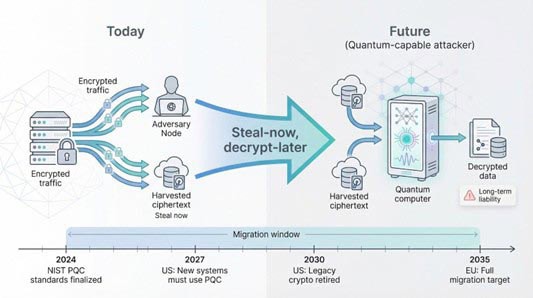
Quantum risk is no longer science fiction. Attackers are already stockpiling encrypted traffic, expecting to decrypt it once quantum hardware matures. That steal-now-read-later tactic turns every database you protect today into a long-term liability.
Deadlines are fixed. U.S. national-security systems must use quantum-resistant algorithms in new deployments by 2027 and retire legacy crypto by 2030. Europe follows close behind, aiming for full migration before 2035. These dates may look generous at first, until you recall how long large organisations needed to drop SHA-1 or switch from RSA to ECC. Crypto upgrades touch every server, appliance, and custom codebase; they devour budgets and calendars.
Regulators learned from those delays. Instead of asking us to “plan for PQC someday,” they now publish procurement playbooks that sort products into ready and obsolete columns. Buy the wrong gear now and you pay twice: once for the rollout, again for the rushed replacement when audits land.
That reality raises the stakes for vendor selection. We are not comparing shiny features. We are choosing partners who will protect data through the most disruptive cryptography transition of our careers. Marketing slogans cost little. Verifiable evidence, such as standards compliance, proven deployments, and credible performance numbers, separates tomorrow’s trusted suppliers from tomorrow’s cautionary tales.
Post-quantum diligence is not about predicting the future. It is about compelling vendors to prove they already live in it.
How we built the red-flag scorecard
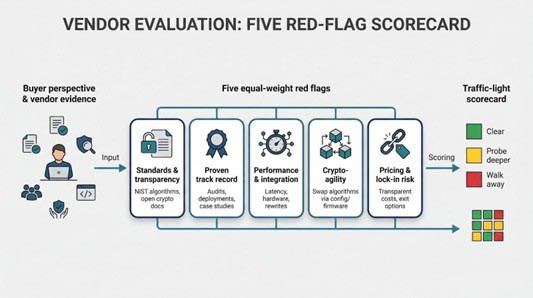
To keep the comparison honest, we started from the buyer’s perspective, not press-release hype. Our team reviewed more than twenty vendors, sifted product sheets, audits, customer case studies, and open-source repositories. Then we ran every offering through five filters we call red flags. Miss one and you court trouble; miss several and you risk a future outage.
The first filter is Standards compliance and transparency. CISA’s January 2026 advisory draws a bright line: federal buyers should halt purchases that lack NIST-approved algorithms or clear cryptographic documentation. If a vendor hides behind proprietary math or refuses to show its code, that is an instant strike.
Second comes Proven track record. We looked for independent audits, production deployments, or at least public pilots. No references, no ranking.
Third is Performance and integration realism. Post-quantum keys enlarge handshakes and certificates; any vendor that glossed over latency, hardware needs, or software rewrites failed this test.
Fourth, Crypto-agility. Standards will evolve. Solutions must swap algorithms quickly with a firmware update or configuration flag, not with a forklift upgrade.
Finally, Pricing clarity and lock-in risk. Hidden usage fees or a black-box cloud that traps your keys earn a red mark.
We weighted each criterion equally, then validated our approach against external scoring models, including AI Journal’s February 2026 “Top 9 PQC Solutions Compared,” which also highlights security, integration, and cost factors.
The result is a simple traffic-light matrix: green means clear, yellow means probe deeper, red means walk away. In the next sections you will see where leading vendors shine or stumble.
Red flag #1: proprietary or non-standard crypto
The most serious warning sign is a vendor who claims to be “quantum-safe” yet refuses to name the maths that make it so.
NIST spent six years stress-testing hundreds of algorithms in public view. Only a handful—Kyber for key exchange; Dilithium, Falcon, and SPHINCS+ for signatures—earned approval in 2024. CISA’s 2026 procurement guide echoes the point: federal buyers should reject any product that lacks those algorithms or hides its implementation details.
Secrecy breeds surprises. The retired SIKE and Rainbow schemes looked solid until researchers cracked them in days. If a start-up waves a “patented cipher” instead of Kyber or Dilithium, you may end up on the next security-failure headline.
Project Eleven shows the right approach. It publishes white papers, open-sources its client libraries, and binds standard lattice signatures to blockchain wallets. That transparency helped it rank high in AI Journal’s February 2026 report.
Vendors pushing quantum key distribution boxes or one-time-pad clouds without protocol details tell a different story. They promise “unbreakable” security but give auditors nothing to verify.
Your move is simple: ask every supplier to list the exact algorithms in use and link to public documentation. If the answer is vague or proprietary, mark the conversation red and move on.
Red flag #2: all talk, no proof
Strong crypto on paper means little until real users hammer it in production.
Many “quantum-safe” start-ups stall at this stage. Slick demos spread online, yet few vendors publish independent code audits, throughput benchmarks, or customer case studies. When we asked for references, several admitted they were “in stealth pilots” no one could name. That is not a track record; it is spin.
The gap matters. Implementation bugs, not broken math, cause most breaches. A recent side-channel flaw in an open-source Rust PQC library proved that new algorithms bring new attack surfaces. You do not want your crown-jewel data serving as a vendor’s beta test.
Now, compare that with SandboxAQ’s FedRAMP-ready deployment in U.S. government clouds and PQShield’s silicon IP already shipping in smart cards. Those milestones show engineers have faced memory limits, embedded tool chains, unexpected traffic spikes, and survived.
Your due-diligence checklist:
- Ask for at least one named customer in production.
- Request a summary of any third-party security audit, even if it requires an NDA.
- Insist on performance numbers gathered outside a lab.
If a vendor cannot supply that evidence today, expect to fund the bug hunt tomorrow.
Red flag #3: performance and integration blind spots
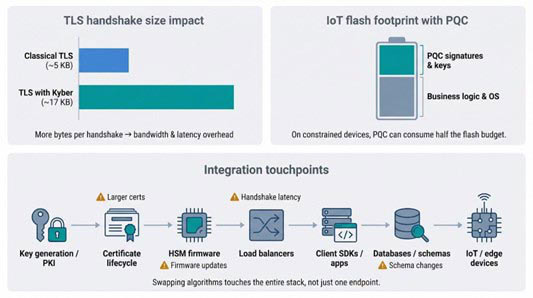
Post-quantum algorithms bring heavier keys, larger certificates, and higher compute cost. That overhead does not disappear because a slide deck claims “seamless.”
A pure Kyber handshake can swell a TLS packet from about five kilobytes to seventeen. Multiply that by every connection on your busiest API cluster, and you feel the drag in bandwidth bills and user latency. On low-power IoT nodes, a lattice signature may consume half the flash budget before business logic even loads.
Good vendors surface these realities early. PQShield publishes chip benchmarks that show how hardware acceleration cuts signing delay from milliseconds to microseconds, and Keyfactor documents the extra bytes its hybrid certificates add to each login so teams can forecast storage growth.
Poor vendors gloss over the issue. They demo a single encrypted chat on a gigabit link, ignore queuing delay, and claim there is “no noticeable impact.” They also forget that swapping algorithms touches certificate lifecycles, HSM firmware, load-balancer ciphers, client SDKs, and sometimes database column widths.
Before you sign, demand a full walkthrough of the integration path, from key generation to log rotation. Ask for real numbers—handshake size, CPU cost, memory footprint—on hardware that matches yours. Silence is proof the testing never happened.
Red flag #4: one-and-done designs that ignore tomorrow
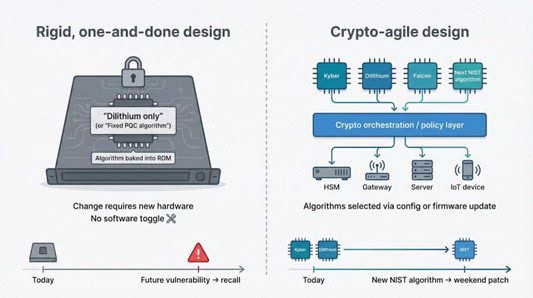
Post-quantum migration is an ongoing project, not a finish line. The algorithms blessed by NIST today are our best tools, yet cryptography evolves. Fresh attacks surface, new schemes join the standard set, and regulators revise guidance. A security stack frozen to one algorithm will spoil quickly.
Crypto-agility solves that problem. The ability to swap key-encapsulation or signature algorithms with a software flag or quick firmware flash decides whether an upgrade is a weekend patch or a multimillion-dollar hardware refresh.
Forward-thinking vendors plan for this reality. QuSecure’s orchestration console discovers every cryptographic endpoint, then lets teams roll out new cipher suites in phased waves. Thales and Entrust commit, in writing, to ship firmware updates that add each NIST release to their HSMs within ninety days. Those promises translate into project plans you can budget.
Rigid products tell a different story. Some IoT chips hard-code Dilithium in a ROM bootloader to save pennies on flash. That choice looks efficient until a future vulnerability forces a recall. A few gateway appliances support Kyber but need an entirely new chassis for Falcon. That is not agility; that is a trapped investment.
Your action item: request a roadmap. Ask each supplier, “How quickly can you add a newly standardised algorithm, and how will that update reach our production fleet?” If the answer involves shipping new hardware or “TBD,” treat it as a red flag.
Red flag #5: hidden costs and vendor lock-in
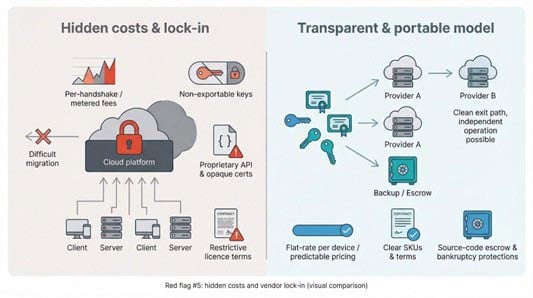
Quantum-safe security is a marathon, so the pricing model you accept today follows every mile ahead.
Some vendors quote a friendly subscription for pilot scale, then increase fees once certificates roll out company-wide. Others route every key exchange through their cloud, putting your uptime and compliance at the mercy of someone else’s SLA and price list.
Lock-in appears in subtler ways too. A proprietary API issues certificates in an opaque format. A hardware appliance keeps private keys in non-exportable blobs. A licence ends support if you migrate data to another provider. Each wrinkle narrows your exit lane and inflates the future bill.
Transparency looks different. Open-format keys you can back up anywhere. Flat-rate licences that scale by device, not traffic spikes. Source-code escrow and bankruptcy clauses that let you maintain the software if the start-up folds. Established vendors sometimes overcharge, yet they publish SKU sheets and stay in business long enough to honour them.
During procurement, ask direct questions: “What happens to our keys if we cancel?” “How will pricing change when we move from pilot to production?” “Can an independent team operate this stack without your cloud?” If the answers are vague, treat the fine print as a warning.
Cryptography wins when it fades into the background. Your finance team should never track per-handshake bills, and your ops crew should not beg a single vendor for emergency patches. Pick contracts that keep you in control.
Vendor comparison matrix: how leading solutions stack up
With the five red flags fresh in mind, we turned our scorecard on seven vendors that dominate most short lists: Project Eleven, SandboxAQ, QuSecure, PQShield, Keyfactor / Entrust, Qrypt, and ID Quantique. Each takes a different approach—blockchain, cloud SaaS, hardware IP, or quantum key distribution—so the exercise surfaces patterns a typical “top ten” list can miss.
We graded every vendor green, yellow, or red against the five criteria, then counted flags. One red is not an automatic rejection, yet two or more signal costly work-arounds you should factor into any deal. The full traffic-light matrix sits below for quick scanning.
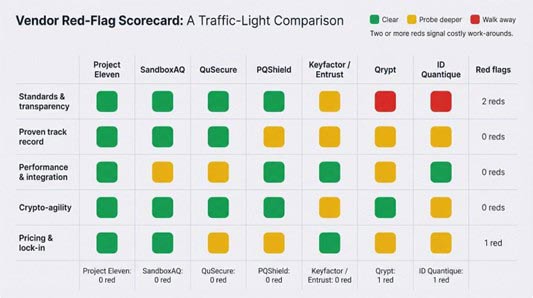
Highlights:
- Project Eleven posts a clean sheet. Standards-based crypto, open code, public pilots on Solana, and a clear roadmap earn five greens.
- SandboxAQ also fares well. Its FedRAMP progress shows maturity, though performance depends on optional hardware acceleration, so we mark integration yellow.
- PQShield shines on performance as its silicon cores cut software latency, yet device-licence pricing may surprise at fleet scale.
- Qrypt and ID Quantique score red on the first criterion because their core offerings fall outside NIST PQC. They suit niche use cases, but you will need parallel controls for mainstream workloads.
This colour-coded view distils a hundred pages of research into a one-minute gut check. Use it to drive vendor calls toward the flags we surfaced, not the features they want to highlight.
Emerging trends and your next moves
Post-quantum security will keep evolving long after this buying cycle. Two shifts are already forming the next wave.
First, NIST plans to release additional digital-signature algorithms in the coming months. Teams that chose crypto-agile designs can apply them with a routine patch. Everyone else will face an urgent change window. Check that your shortlisted vendors subscribe to NIST mailing lists, contribute code to Open Quantum Safe, and test new primitives in beta branches. These habits show they will keep you current.
Second, formal certifications are catching up. FIPS 140-3 labs are drafting test vectors for Kyber and Dilithium. Products that earn those seals in 2027 will stand out with auditors, insurers, and procurement desks. Ask vendors when they plan to submit and whether revalidation costs land on you.
What should we do right now?
- Inventory every place your organisation relies on encryption—VPNs, TLS terminations, database connections, firmware updates. You cannot protect what you do not count.
- Pilot one quantum-safe deployment this fiscal year. A non-critical web service or internal VPN works well. The exercise uncovers integration snags early and builds muscle memory.
- Embed roadmap clauses in new contracts. Require vendors to add future NIST algorithms within a fixed window, and to deliver signed performance reports after each major release.
Conclusion
The five red flags—proprietary crypto, missing proof of deployment, performance blind spots, rigid designs, and hidden lock-in—form a practical filter that separates credible quantum-safe vendors from marketing noise. Apply them as a scorecard during every vendor call, and the field narrows to partners who can back their promises with audits, benchmarks, and named customers.
Post-quantum migration is not a one-time purchase. Standards will evolve, new algorithms will join the approved list, and today’s hardware will eventually need firmware refreshes. The vendors who earn your trust now are the ones already planning for that next cycle—shipping crypto-agile architectures, committing to NIST update windows, and publishing transparent pricing that scales with your fleet.
Start with an inventory of every cryptographic endpoint in your environment, pilot one quantum-safe deployment this quarter, and embed roadmap clauses in every new contract. The quantum era rewards preparation, not panic. Move methodically, demand evidence at each step, and the transition becomes a managed project with clear milestones rather than a scramble driven by the next breach headline.
