
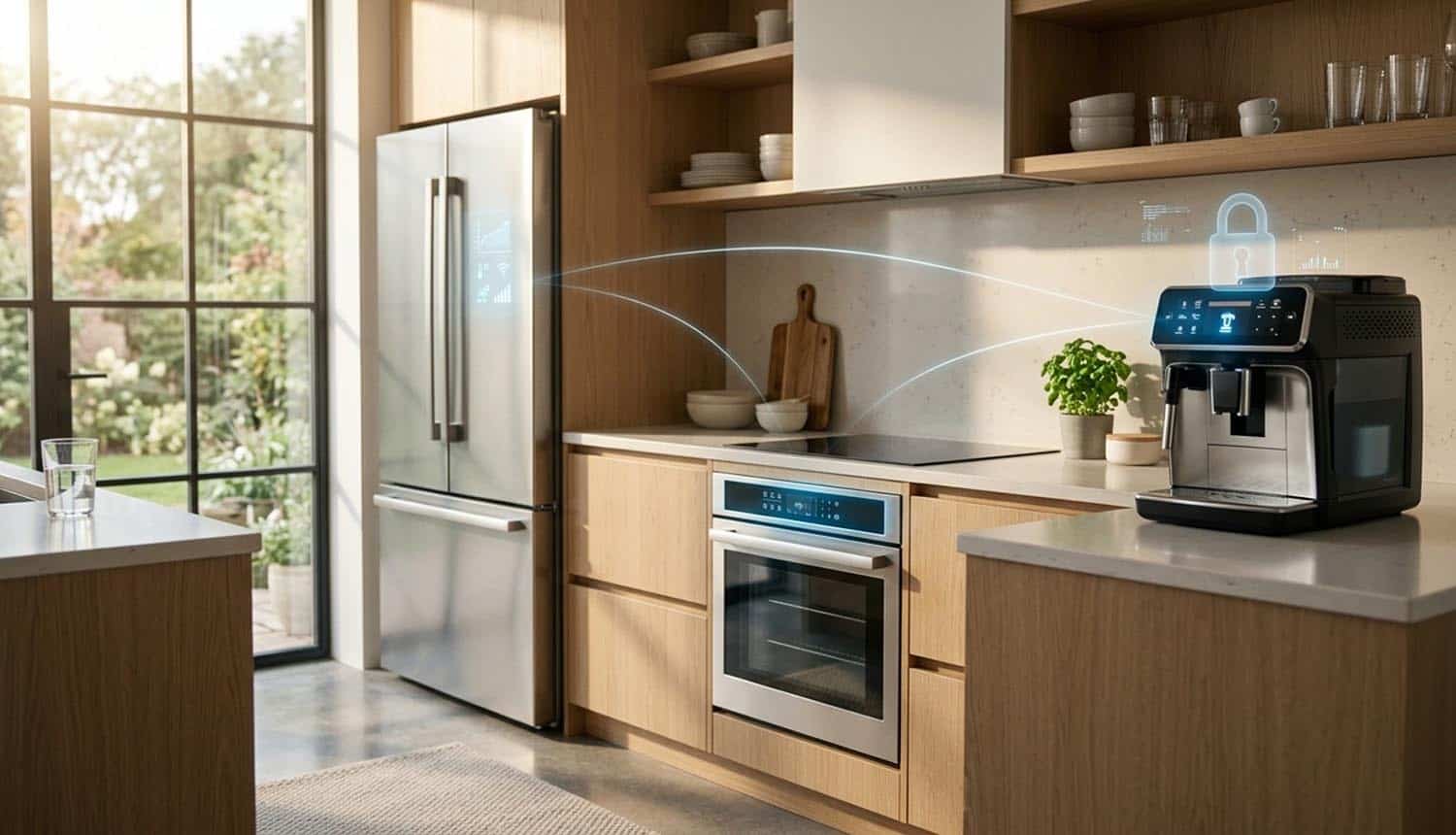

Smart kitchen appliances have quietly become one of the most overlooked entry points in home and commercial network security. From connected ovens and coffee machines to refrigeration units and dishwashers, these devices are now firmly embedded in the broader internet of things ecosystem — and with that connectivity comes significant risk. IoT security in the kitchen is no longer a niche concern reserved for enterprise IT teams; it affects households, restaurants, and facility managers alike. As the number of connected appliances grows year over year, so does the attack surface available to malicious actors. Understanding how these devices become vulnerable, what consequences that vulnerability carries, and how to address the underlying security challenges is essential for anyone managing a connected kitchen environment in 2026. This article examines the threat landscape, explores concrete solutions, and offers practical guidance for securing smart kitchen infrastructure at every level.
The Rise of Connected Kitchens: Why IoT Security Matters Here
Kitchen appliances were once entirely isolated — mechanical, analog, and inherently difficult to attack remotely. The shift toward smart devices changed that equation fundamentally. Today, a single commercial kitchen may contain dozens of IoT devices, each capable of connecting to a Wi-Fi network, exchanging data with cloud platforms, and receiving remote firmware updates.
The appeal is genuine: remote temperature monitoring, energy consumption tracking, predictive maintenance alerts, and integration with smart home ecosystems all deliver measurable value. However, manufacturers have historically prioritized functionality and cost efficiency over security hardening. The result is a category of devices that often ships with weak default credentials, unencrypted communication channels, and infrequent patch cycles — precisely the conditions that make IoT security attacks both easy to execute and difficult to detect.
In 2026, the global installed base of IoT devices in consumer and commercial kitchens numbers in the hundreds of millions. Each one represents a potential foothold for attackers looking to pivot deeper into a network.
Security Challenges in Smart Kitchen Environments
Weak Authentication and Default Credentials
One of the most persistent IoT security threats involves devices that ship with factory-set usernames and passwords that users never change. Many smart kitchen appliances expose a web-based management interface or communicate with a companion app using credentials like “admin/admin” or “user/1234.” Automated scanning tools can identify and exploit these devices within minutes of them going online.
The problem is compounded by the absence of enforced password policies. Unlike enterprise routers or NAS devices, smart kitchen hardware rarely requires users to set a unique password during initial setup. Even when a device does prompt for a new password, users frequently skip the step or choose trivially guessable alternatives.
Unencrypted Data Transmission and Firmware Vulnerabilities
Many IoT devices in the kitchen segment transmit operational data — temperature readings, usage logs, scheduling commands — over unencrypted channels. An attacker positioned on the same network, or intercepting traffic at the Wi-Fi level, can capture this data, modify it, or inject malicious commands into the stream. In a commercial context, tampering with temperature logs for refrigeration units carries both safety and regulatory implications.
Firmware vulnerabilities represent an equally serious threat vector. Manufacturers release patches irregularly, and many appliances lack an automatic update mechanism entirely. Devices running outdated firmware may contain known, publicly documented vulnerabilities that exploit kits can leverage with minimal technical skill. A connected Fridge with unpatched firmware, for instance, can serve as a persistent network entry point long after the vulnerability has been publicly disclosed.
Exposure to DDoS Attacks and Botnet Recruitment
Smart kitchen appliances are frequently recruited into botnets without the owner’s knowledge. Once compromised, these devices are directed to participate in coordinated DDoS attack campaigns targeting third-party infrastructure. The infamous Mirai botnet demonstrated in earlier years how unsecured IoT devices — including household appliances — could be weaponized at scale, generating traffic volumes capable of knocking major services offline.
In 2026, the sophistication of these recruitment campaigns has increased considerably. Modern botnets use encrypted command-and-control channels, making detection harder. A compromised smart oven or connected refrigerator may contribute to a DDoS attack while appearing entirely functional to its owner, generating no obvious symptoms beyond slightly elevated bandwidth consumption.
Solutions and Approaches for Securing Connected Kitchen Infrastructure
Network Segmentation and the Guest Network Strategy
The single most effective architectural measure for reducing risk from IoT devices is network segmentation. By isolating smart kitchen appliances on a dedicated network segment — separate from computers, smartphones, and sensitive business systems — organizations and households can contain the blast radius of a compromised device.
A guest network configuration is a practical implementation of this principle available even on consumer-grade routers. Placing all kitchen IoT devices on a guest network means that even a fully compromised appliance cannot be used to pivot laterally toward more sensitive systems. Traffic from the guest network should be limited to outbound internet access only, with inter-device communication blocked unless explicitly required.
Enterprise environments benefit from more granular VLAN-based segmentation, combined with firewall rules that enforce strict allowlists for the ports and protocols each device category legitimately requires.
IoT Platform Security and Firmware Management
IoT platform security refers to the combination of practices governing how device firmware is managed, how cloud integrations are secured, and how API communications are authenticated. Organizations deploying smart kitchen appliances at scale should establish a formal process for:
- Inventorying all connected devices and their firmware versions
- Monitoring vendor security advisories for affected products
- Applying firmware updates promptly when patches become available
- Disabling cloud features and remote access functions that are not actively used
For manufacturers, adopting a secure-by-design approach means shipping devices with unique per-unit credentials, enforcing HTTPS for all management interfaces, signing firmware images cryptographically, and providing a clear end-of-life support timeline so operators know when a device will stop receiving security patches.
Authentication Hardening and Credential Management
Addressing the authentication gap requires action at both the user and manufacturer level. Users should change default credentials immediately upon device setup, use strong and unique passwords for each appliance management interface, and where available, enable multi-factor authentication for companion apps.
Password managers reduce the friction of maintaining unique credentials across many devices. For commercial kitchens managing large fleets of appliances, a privileged access management solution can centralize credential storage and rotation, ensuring that no single compromised credential provides broad access.
Manufacturers can support these efforts by enforcing password changes during first-time setup, displaying clear security configuration prompts during onboarding, and logging authentication events in a format that can be ingested by security monitoring systems.
Implementation Best Practices for 2026
Securing smart kitchen infrastructure requires a layered approach that addresses both technical controls and operational habits. The following practices represent the current baseline for responsible IoT security management:
- Conduct a device inventory. Operators should know exactly which devices are connected to their network, which firmware versions they are running, and which vendor provides support for each.
- Apply updates promptly. Devices with automatic update capabilities should have that feature enabled. Devices requiring manual updates should be checked against vendor advisories at least monthly.
- Segment the network. IoT kitchen devices belong on an isolated network segment with restricted lateral movement capabilities.
- Disable unnecessary features. Universal Plug and Play (UPnP), remote access services, and cloud integrations that are not actively used should be disabled to reduce the attack surface.
- Monitor network traffic. Anomalous outbound connections from kitchen appliances — unexpected destinations, unusual volumes, or communication on non-standard ports — may indicate compromise and warrant investigation.
- Replace end-of-life devices. Appliances that no longer receive firmware updates from their manufacturers represent an unacceptable and growing risk; they should be replaced with actively supported alternatives.
Applying these practices consistently transforms a fragmented collection of connected appliances into a manageable, defensible infrastructure layer rather than an unmonitored liability.
Frequently Asked Questions
What makes smart kitchen appliances particularly vulnerable to IoT security threats?
Smart kitchen appliances are particularly vulnerable because they combine persistent internet connectivity with historically weak security design. They frequently ship with default credentials, lack automatic update mechanisms, and use unencrypted communication protocols. Because users interact with them primarily as kitchen tools rather than networked computers, security configurations are rarely reviewed after initial setup — leaving vulnerabilities unaddressed for months or years.
How does a DDoS attack relate to compromised kitchen IoT devices?
A DDoS attack uses large numbers of devices to flood a target with traffic, overwhelming its capacity to respond to legitimate requests. Compromised kitchen IoT devices — including smart ovens, coffee machines, and refrigerators — are recruited into botnets that execute these attacks. The device owner typically notices no disruption to normal appliance function, while their hardware contributes to attacks against entirely unrelated targets.
Is a guest network sufficient to protect a home from smart appliance vulnerabilities?
A guest network significantly reduces risk by preventing a compromised appliance from accessing other devices on the primary network. However, it is not sufficient on its own. Firmware updates, strong credentials, and disabling unused remote access features remain necessary. A guest network limits lateral movement after a breach but does not prevent the device itself from being compromised or used as part of a botnet targeting external systems.
