
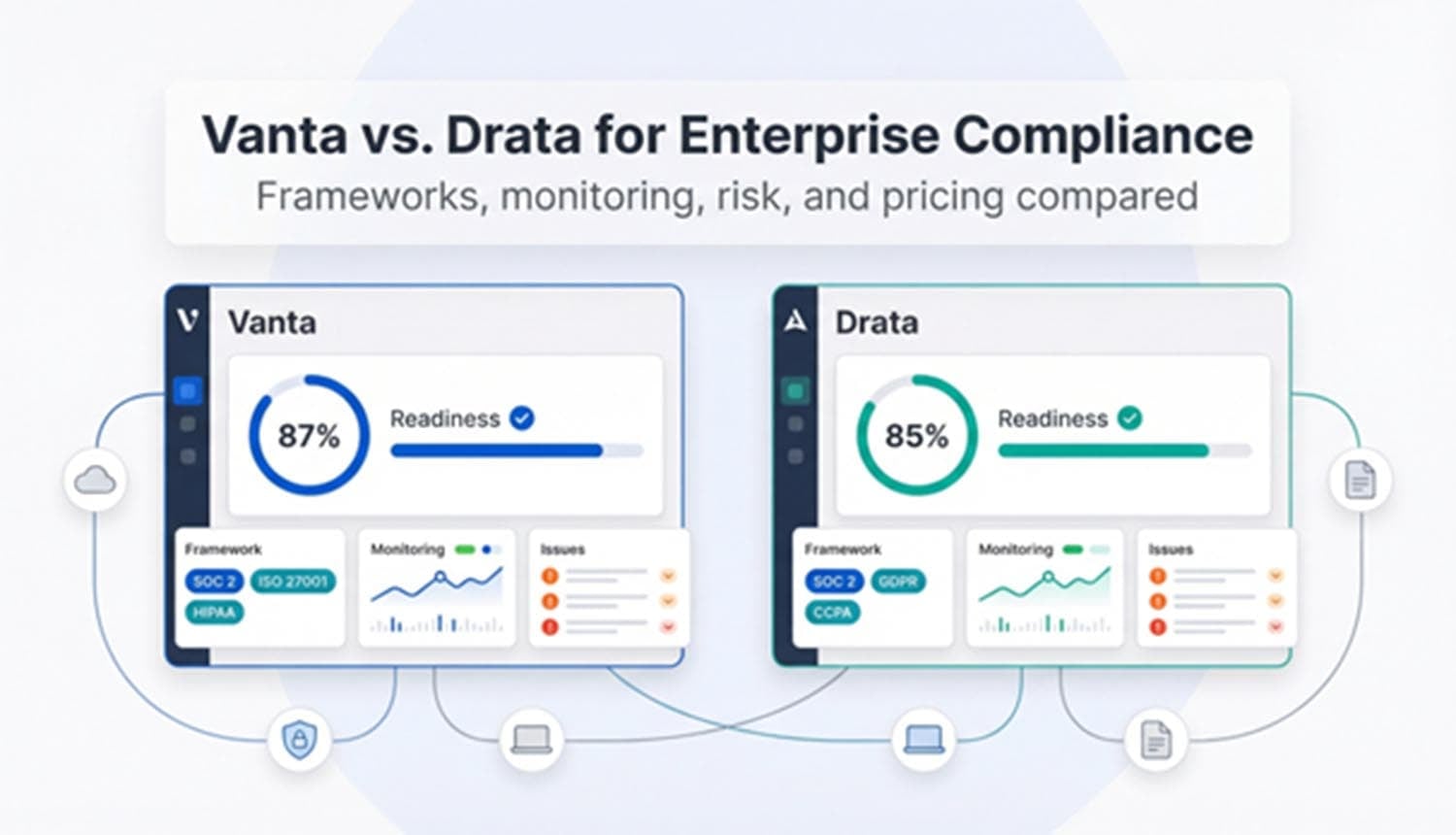

Security audits aren’t once-a-year fire drills anymore—they’re a live feed. Regulators and customers now expect proof of control health 24/7. That demand has sparked a new wave of automated compliance platforms, and two names dominate the field: Vanta and Drata. Both slash audit-prep time, surface issues in real time, and turn compliance into a revenue signal, but they approach the challenge differently. In this guide, we compare their framework coverage, monitoring cadence, integrations, risk tooling, pricing, and more so you can choose the best fit for your enterprise.
Company background and market context
Vanta (founded 2018, San Francisco). As a July 2025 Reuters report stated, the company closed a $150 million Series D, lifting total funding to $504 million and valuing the firm at $4.15 billion, a 69 percent jump over 2024. The customer count has more than doubled in two years, reaching 12,000 organizations across 58 countries. The fresh capital will fund AI-driven trust features and global expansion.
Drata (founded 2020, San Diego). According to private-market intelligence firm Sacra, the automation-focused rival hit a $2 billion valuation after a $200 million Series C in late 2022 and has raised $328 million in total. TechCrunch reported that, in 2025, Drata purchased SafeBase for $250 million to add questionnaire automation to its “modern GRC” platform.
Both vendors continue to acquire complementary products. Vanta bought Trustpage to bolster its public Trust Center, later rolled out third party risk management capabilities it says can cut vendor security assessment time by up to 50 percent, while Drata previously purchased Harmonize and oak9 to deepen risk and DevSecOps coverage. With fresh capital, double-digit ARR growth, and expanding suites, both appear positioned to outlast the broader compliance-tool shake-out, which reassures risk-averse enterprise buyers evaluating multiyear contracts.
Framework coverage and multi-framework handling
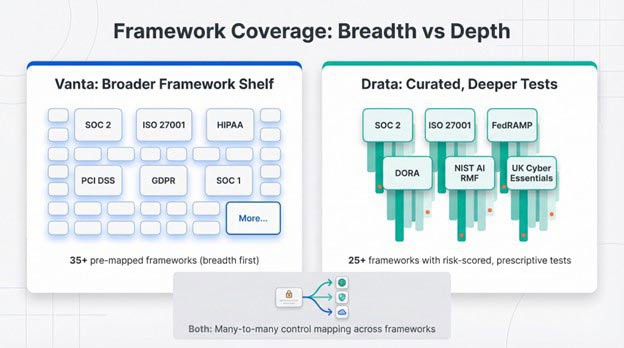
Breadth still belongs to Vanta. As of December, 2025 the company lists more than 35 pre-mapped frameworks, from SOC 2 and ISO 27001 to AI-centric ISO 42001 and regional rules such as Australia’s CPS 234.
Drata has continued expanding its framework coverage and supports 25 frameworks (21 fully mapped and four “requirement only” sets) including FedRAMP Rev 5, DORA, NIST AI RMF, and UK Cyber Essentials. With fewer total frameworks, Drata focuses engineering time on deeper, prescriptive tests for each control.
Both tools support many-to-many control mapping. Vanta calls it cross-mapping, while Drata labels it “test once, comply many.” One access-control policy can link to SOC 2 CC6, ISO 27001 A.9, and HIPAA §164.308 in a single click rather than three evidence folders.
Speed counts when regulators move quickly (see EU DORA or the draft EU AI Act). Vanta’s broader library typically publishes new frameworks first. Drata often follows within a quarter, and its release notes pair each new standard with focused, low-noise tests.
Put simply:
- If you manage a global mix of standards, including niche or emerging rules, Vanta’s larger shelf reduces the need for extra tools.
- If you prefer a tighter list of high-value frameworks and prescriptive, risk-scored tests, Drata’s curated set feels cleaner.
Either way, both platforms retire 90-row spreadsheets and show auditors that one living control set can satisfy many masters.
Always-on monitoring styles
Compliance hinges on catching drift before users or auditors notice. At this stage, the two platforms take different paths.
Vanta: speed first. The service runs more than 1,300 automated tests each hour across cloud, identity, and device integrations. You get a near-real-time dashboard that turns red the moment someone disables MFA or spins up an untagged S3 bucket.
Drata: context first. By default, Vanta leans into high-frequency polling, running tests hourly to catch drift almost immediately. Drata emphasizes a ‘Continuous Compliance’ model that balances real-time event tracking with a nightly reconciliation sync (defaulting to 7 p.m. PT). Vanta’s approach favors instant remediation, while Drata’s cadence is designed to reduce alert fatigue by grouping non-critical findings.
Neither cadence is inherently better.
- Teams with engineers on call and a preference for instant alerts gravitate to Vanta’s ticker-style feed.
- Teams that favor a calm signal-to-noise ratio often prefer Drata’s daily digest with built-in prioritization.
Choose the tempo that matches your culture and staffing model; any automation beats manual spot checks.
Internal risk management
Good compliance checks controls; great compliance closes the loop on risk. Here the two rivals take different approaches.
Drata: risk engine inside the box. Open the Risk tab and you will see a pre-loaded library of more than 200 risks sourced from NIST SP 800-30, ISO 27005, and OCR SRA guidelines. Choose a scenario, assign an owner, score likelihood and impact, and Drata links the related controls. It then schedules automated tests to confirm treatment. The entire cycle (identify → score → treat → retest) runs in one view, no spreadsheets required.
Vanta: flexible register with added configurability. Vanta’s 2025 risk module lets you build multiple registers, import CSVs, customize scoring scales (1–20), and connect risks to failing controls in real time. It needs more manual setup than Drata’s library but rewards teams that already run formal GRC workflows with deep customization.
Day-to-day impact:
- Drata updates its register the moment a linked control fails, so risk owners see changes right away.
- Vanta allows full exports and custom scoring, which can keep license costs lean.
Your choice depends on whether automated, opinionated risk analytics outweigh granular customization in this year’s priorities.
Connecting to your stack
Integrations are the heartbeat of automated compliance: if a platform can’t “see” a system, it can’t test it.
Vanta: widest and deepest set. As of December 2025 Vanta lists more than 400 pre-built integrations—from Adaptive Shield and Atlassian Cloud to global HR platforms like Rippling. Chances are the SaaS app your finance team adopted last quarter already sits in the dropdown. Point, click, and Vanta starts checking encryption, role assignments, or login events within minutes.
Drata: focused ecosystem. A November 2025 momentum update cites more than 300 integrations, with 100 added in a single year. Drata supports common engineering and cloud connections like GitHub and AWS, so teams can pull in signals around access, change activity, and configuration posture. Still, Vanta wins on both breadth and depth. It spans more systems overall and tends to provide more mature, detailed checks across a wider set of integrations, which can reduce gaps when auditors ask for system-specific evidence.
APIs tell a similar story. Vanta’s 2024 REST API opened read-write endpoints for bulk evidence upload, custom alerts, and BI exports. Drata expanded its GraphQL API in late 2024 to support evidence pushes, custom control creation, and SCIM provisioning events. Retrieval is still smoother than orchestration in Drata, but the gap is closing.
In short:
- Need a connector for every specialty tool? Vanta’s breadth speeds onboarding.
- Running a standardized stack and craving granular telemetry? Drata’s depth pays off.
Choose the path that matches your environment; both vendors let you build private integrations if the catalog ever falls short.
Laptops and other endpoints
Endpoints remain the weakest link in many control sets, so how each platform monitors laptops and phones can determine audit success.
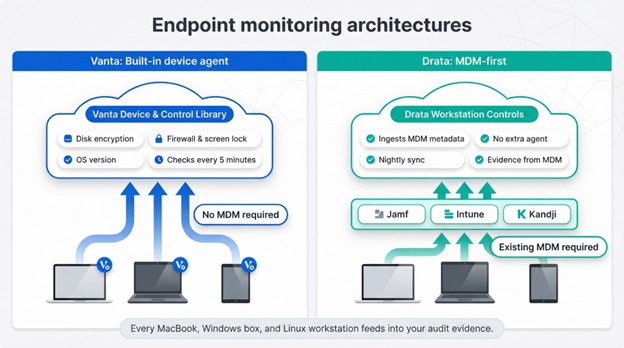
Vanta: built-in device agent. Employees install the Vanta Device Monitor, which checks disk encryption, operating-system version, firewall status, screen-lock timers, and roughly 20 other settings every five minutes. The agent pushes evidence straight into Vanta’s control library, giving distributed teams one install and immediate coverage even without a mobile-device-management (MDM) tool.
Drata: MDM-first. Drata offers a hybrid approach. It integrates seamlessly with MDMs like Jamf, Intune, and Kandji for agentless monitoring, but also provides a lightweight, read-only Drata Agent for organizations that haven’t deployed an MDM yet. This allows teams to mix and match—using the agent for contractors or BYOD users while relying on MDM for corporate fleets—ensuring no device goes unmonitored.
In practice:
- Start-ups and midsize firms without formal IT operations often lean on Vanta’s agent for an instant security baseline.
- Enterprises with an established MDM footprint stay lean with Drata and avoid adding another background process.
Either route lets the auditor see every MacBook, Windows box, or Linux workstation under the same spotlight as your cloud stack. Choose the method that mirrors your device-management reality.
Interface and onboarding
First impressions still diverge.
Vanta: minimalist, self-serve. You land on a single progress ring plus a brief to-do list; connect integrations and watch the readiness score rise in near real time. The lightweight flow means new users rarely need help articles to find the next step.
Drata: structured, concierge. Drata opens to colored bars for every framework and a left-hand wizard that locks the sequence (connect systems → upload or adopt policies → assign control owners). It feels busier, but the guardrails prevent skipped steps and scale cleanly as headcount grows.
How long does it really take? According to thousands of G2 reviewers, the median “time to implement” is about two months for both platforms. Vanta marketing still promises “weeks not months,” while Drata’s documentation notes that completing policy templates and acknowledgments can add a few days to a few weeks to the wizard flow.
In practice:
- Small teams that already have policies in place often finish Vanta’s checklist in under a week.
- Larger organizations that use Drata’s policy templates and role assignments spend more time up front but face fewer back-and-forths before audit kickoff.
Both tools offer in-product guidance through hover tips and knowledge-base links. The difference is live help: Drata’s chat icon routes to compliance specialists during business hours, while Vanta relies on asynchronous tickets and community docs.
Pick the style that fits your culture: quick self-service or coached, step-locked onboarding. Either way, the data show you will invest roughly the same total calendar time; the difference is when and where that effort occurs.
How the quotes usually shake out
Neither vendor publishes list prices, but recent deal data and buyer communities provide a workable range.
Vanta
- Essential plans for young teams start around $12K–$18K per year (SOC 2 plus basic integrations).
- Adding ISO 27001, HIPAA, or the Trust Center pushes quotes into the $30K–$60K band, with enterprise bundles occasionally topping $80K.
- Discounts average about 20 percent for annual terms and 30 to 35 percent for two-year commits, according to 2025 Vendr benchmarks.
Drata
- Public buyer forums place the Essential tier at $7.5K–$15K, Foundational near $15K–$25K, and Advanced above $40K, with large GRC roll-outs exceeding $100K.
- Vendr data lists prices of $37K–$40K but shows median negotiated discounts of 42 to 55 percent when multi-year terms apply.
- Renewal spikes are a known risk: users report year-two jumps from $7.5K to $20K when frameworks or headcount grow.
Key levers on both sides: employee count, number of frameworks, and premium add-ons such as vendor risk, SCIM, or custom roles. Ask sales to break out every module line by line; clarity now prevents renewal sticker shock later.
Negotiation tip: keep both vendors on the short list until signature. Competitive pressure often secures extra support hours or faster SLA commitments, which can be more valuable than squeezing the last five percent off annual cost.
Decision matrix and use-case scenarios
Think of the choice as two sliding scales: urgency (how quickly you must certify) and complexity (number of frameworks, depth of risk management, DevOps maturity).
| Scenario | Urgency | Complexity | Likely fit | Why it matters |
|---|---|---|---|---|
| No MDM, SOC 2 due next quarter | High | Low to medium | Vanta | Built-in device agent plus hour-level monitoring can save weeks of prep. |
| Jamf already deployed; need unified risk and control view | Medium | Medium to high | Drata | Imports Jamf data, links to the risk register, and avoids extra agents. |
| Board requests every emerging framework and public trust portal | Medium | High | Vanta | 35+ frameworks and a polished Trust Center cut tool sprawl. |
| Auditor demands in-app collaboration and IaC evidence trails | Low to medium | High | Drata | Audit Hub plus oak9 IaC scans provide granular, shareable evidence. |
Conclusion
Vanta and Drata both modernize enterprise compliance by turning audits into a continuously measured program instead of a yearly scramble. The right choice depends less on “which is better” and more on how your organization operates: how many frameworks you need to manage at once, how quickly you want drift surfaced, how standardized your stack is, and how much structure you want in onboarding and ongoing workflows.
If you want broad framework coverage, fast setup, and a wide connector catalog that starts producing compliance signals quickly across a mixed environment, Vanta is typically the cleaner fit. If your priority is deeper, more prescriptive testing and more structured workflows that map closely to how mature security and engineering teams operate, Drata can be a strong match. Either way, align the platform to your staffing model, audit timeline, and control owners, then run a short proof of concept against your real integrations to see which system produces clearer evidence and fewer surprises.
FAQ
Which platform supports more compliance frameworks out of the box?
Vanta typically lists more pre-mapped frameworks overall, while Drata covers the major standards and continues expanding its catalog.
Can both tools handle multiple frameworks at the same time without duplicating work?
Yes. Both support many-to-many control mapping so one control can satisfy requirements across SOC 2, ISO 27001, HIPAA, and more.
Do these platforms replace a full GRC suite?
They can cover a large portion of compliance operations, evidence collection, and some risk workflows. Enterprises with extensive GRC requirements may still keep a dedicated GRC system for broader governance needs.
Which platform has more integrations?
Vanta is often cited for its breadth of connectors. Drata has many integrations as well and is frequently positioned as deeper in certain engineering and DevSecOps oriented checks.
What is the biggest difference in endpoint monitoring?
Vanta offers a built-in device agent for endpoint evidence. Drata typically relies on pulling device compliance data from your existing MDM.
