


2023 has been a record-breaking year – but unfortunately, not for positive reasons. In 2023, there were over 5 billion security incidents, spanning across every sector and seemingly using every possible actor vector. Of these vectors, the usual suspects still reign supreme, with malware, ransomware, and phishing accounting for the majority of threats.
Yet, the past few years have seen one threat repeatedly increase in frequency. IDOR (Insecure Direct Object Reference) attacks are now more common than ever, with businesses around the globe scrambling for a way to protect themselves. Security Intelligence ranked IDOR as one of the top five security threats that companies are currently facing.
In this article, we’ll explore absolutely everything you should know about IDOR attacks, demonstrating what they look like, effective responses to IDOR events, and mitigation strategies.
Let’s dive right in.
What Does an IDOR Attack Look Like?
There are several core methods of initiating an IDOR attack, spanning everything from tampering with a URL to manipulating the value of buttons, APIs, and checkboxes. However, by far, the most common method is when hackers manipulate the core parameters of a web application’s input fields. By doing so, they can gain access to documents, resources, and data.
For the past few years, sites have attempted to crack down on IDOR attacks. Here’s an example from 2018, in which a hacker shared an exploit with Shopify through their bug bounty program. When a store replies to user queries and sends files through this messaging system, it generates a new link. Hackers could then replace the FileName of this link to begin an IDOR attack.
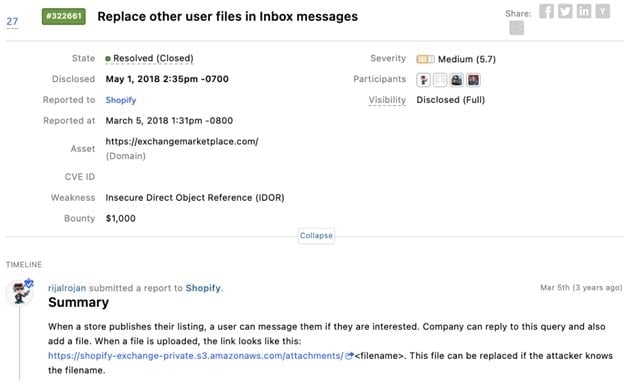
It’s extremely difficult to locate the potential for IDORs, making them notoriously difficult to manage and neutralize for businesses. Due to this, many major companies offer ethical hackers the opportunity to locate them in return for a fixed price.
What are the Consequences of an IDOR Attack?
Any business that doesn’t actively prepare for IDOR attacks likely has vulnerabilities on its website or web application that they are unaware of. When left unattended, a malicious actor that gains entry into your site could execute several actions that jeopardize your security.
Here is just a selection of the potential consequences of an IDOR attack:
- Personal Data Breaches – Hackers can gain entry to hidden parts of your website that you typically keep for authorized parties only. If you store personal data, confidential documents, or financial records on your site, hackers could potentially find and obtain them.
- Compliance Consequences – As a business, it is your responsibility to follow local governmental regulations in terms of data protection. If your site is found to not be doing enough to keep your users’ data safe, it could face charges.
- Financial Loss – By stealing financial records or accounts, hackers who use an IDOR attack to gain entry to your site could begin to use your documents for fraudulent purposes, accessing bank accounts, or stealing the identities of your workforce.
- Data Manipulation – IDOR attacks can grant hackers access to your document repositories. Once inside, they can manipulate or delete data as they see fit, leading to numerous business operations problems down the line.
While not an exhaustive list, these potential consequences demonstrate just how severe a successful IDOR attack on your business can be.
Strategies To Prevent the Threat of an IDOR Attack
While sites where attackers can implement IDOR attacks are difficult to find, they are far from impossible to locate. Moreover, there are several approaches you can take and strategies you can employ that lower the chance of successful IDOR attacks on your website or web application.
Here are some of the leading strategies to prevent an IDOR attack:
- Implement Authorization and Access Controls – Authorization control will define which users on your system can access certain areas. By allocating resources to certain access bands, you can protect your most confidential documents from all access apart from administrator accounts. By pairing this with an authentication system, such as MFA or biometric controls, you can create a secure layer of access that will help thwart many attacks.
- Prevent Client-Side Manipulation – Malicious actors will use direct object access methods from the client side to manipulate your system and gain access. By using indirect references within your server-side logic, you can prevent them from interacting with certain objects on your site. Equally, you can create processes that sanitize user inputs to prevent them from modifying URLs or any forms on your site.
- Monitor User Behavior – By implementing a real-time monitoring system into your cyber defenses, your business will be able to spot any user behavior or interaction patterns that coincide with the typical actions of an IDOR attack. Noticing any anomalies in user behavior and reacting to them can help you mitigate disaster events before they even begin.
- Training – IDOR attacks are a much lesser-known attack vector than other traditional formats. Due to this, your security team might be less experienced when it comes to dealing with this vector. By training them and offering resources that they can use to bring themselves up to speed, you ensure that your team will be more prepared if an IDOR attack occurs.
While each of these strategies imposes additional work for your cybersecurity team, they are well worth it in the long run as they will help to prevent potential hackers from gaining entry into your system and exploiting your data.
Final Thoughts
IDOR attacks are becoming a leading attack vector that businesses must understand and respond to. Over the coming months, organizations should begin to put in place leading strategies to reduce the possibility of an IDOR attack against their business.
While this digital security protection won’t happen overnight, the rising commonality of this attack vector should make it one of your top priorities. Be sure to introduce the strategies outlined in this list and discuss them with your cybersecurity team to discover how they’re preparing for IDOR attacks.
