


In today’s fast-paced business environment, efficient knowledge management is key to maintaining a competitive edge. AI-powered knowledge management systems are revolutionizing the way enterprises handle information by offering advanced search and retrieval capabilities, automated content creation, personalized experiences, and seamless workflow integration. These robust systems enhance scalability, adaptability, and innovation, ultimately leading to increased employee productivity and a significant competitive advantage.
Geniusee expertise in this domain highlights the pivotal role AI plays in modern knowledge management. By leveraging natural language processing (NLP) and machine learning algorithms, AI-powered systems can interpret queries with remarkable accuracy, understanding both context and intent. This technology is being utilized by industry leaders like Grammarly and Duolingo to boost productivity and save time through enhanced knowledge discovery.
The Core Benefits of AI in Knowledge Management
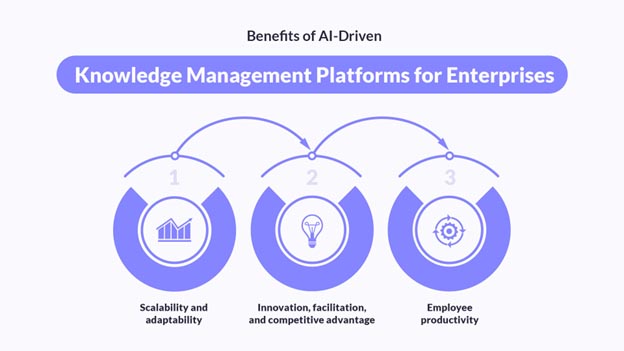
AI-based knowledge management systems offer several key benefits, including:
Scalability and Adaptability
These systems can grow and evolve with your enterprise needs, ensuring that information management remains efficient, regardless of scale.
Innovation Facilitation
By automating routine tasks and providing insights, AI enables employees to focus on creative and strategic activities.
Competitive Advantage
Quick and easy access to accurate information helps enterprises respond faster to market changes and stay ahead of competitors.
Enhanced Employee Productivity
With AI handling repetitive tasks, employees can dedicate more time to high-value work, boosting overall productivity.
The Impact of AI-Driven Knowledge Management Systems on Enterprise Information Handling
Advanced Search and Retrieval
One of the standout features of AI-powered knowledge management systems is their ability to perform advanced search and retrieval. Using NLP and machine learning, these systems can understand and process complex queries to deliver precise results quickly. This capability ensures that employees spend less time searching for information and more time utilizing it effectively.
Automated Content Creation
AI-driven content creation is another transformative aspect of these systems. By analyzing structured data and adhering to SEO best practices, AI can generate relevant and high-quality content automatically. This not only saves time but also ensures consistency and accuracy across all informational assets. Companies like IBM Watson are employing AI to personalize content and enhance customer experiences, demonstrating the potential of AI in content generation.
Personalized Experiences
Personalization is crucial in today’s customer-centric business landscape. AI systems, such as those developed by Panasonic and Humana, use sophisticated algorithms to tailor experiences to individual customer needs. By predicting preferences and behaviors, AI helps companies deliver more targeted and effective interactions, improving customer satisfaction and loyalty.
Automation of Repetitive Tasks
AI excels in automating repetitive and mundane tasks, freeing up employees to engage in more meaningful work. From data aggregation to report generation, AI systems streamline workflows and improve operational efficiency. This automation not only reduces workload but also minimizes errors, enhancing the overall quality of business operations.
Improved Decision-Making
With vast amounts of data generated daily, making informed decisions can be challenging. AI-based knowledge management systems assist in this by providing actionable insights derived from data analysis. By identifying patterns and trends, AI helps managers and executives make better-informed decisions, driving business growth and innovation.
Collaboration and Workflow Integration
Effective collaboration is vital for any enterprise’s success. AI-powered knowledge management systems facilitate this by integrating seamlessly into existing workflows and communication platforms. They aggregate information from various sources, ensuring that all team members have access to the latest data and insights. This integration fosters a collaborative environment where knowledge is easily shared and leveraged for better outcomes.
The Future of AI in Knowledge Management
Artificial intelligence (AI) has made significant inroads into nearly every industry, bringing transformative changes. As AI technology continues to evolve, its potential to handle increasingly complex tasks grows. While it is unlikely that AI will entirely replace human intelligence, it is set to become a major driver of growth. Here’s a glimpse into the future of AI-based knowledge management:
- Enhanced Customer Experience: AI-powered knowledge management systems will offer highly personalized customer experiences, akin to businesses providing each customer with a personalized virtual assistant. These systems will have the ability to understand and anticipate individual customer preferences, leading to more tailored interactions and satisfaction.
- Efficient Data Management: The automation capabilities of AI will allow for the seamless capture and organization of vast amounts of data. This will streamline the process of knowledge delivery, ensuring that pertinent information is readily accessible when needed.
- Insightful Analytics: AI systems will be adept at processing both structured and unstructured data, making it possible to derive valuable insights to support analytics and decision-making. This capability will enhance the strategic planning and operational efficiency of organizations.
- Workforce Integration: According to Gartner, by 2025, over 90% of companies will partner with AI in their workforce. This indicates that AI-driven knowledge management systems will become essential across various critical industries, including healthcare, finance, and retail. The integration of AI will enhance productivity and innovation within these sectors.
- Innovations in Drug Discovery and Fraud Detection: Companies will leverage AI-based knowledge management processes to accelerate drug discovery, detect fraudulent activities, and deliver enhanced value to their customers. This will revolutionize how businesses operate and serve their clientele, leading to significant advancements and competitive advantages.
The integration of AI in knowledge management is poised to revolutionize how organizations manage and utilize information. By offering personalized experiences, automating data processes, providing deep analytics, and becoming an indispensable workforce partner, AI will drive unprecedented growth and innovation. As we move towards this future, embracing AI-powered knowledge management will be crucial for businesses aiming to stay ahead in an increasingly competitive landscape.
Conclusion
AI-powered knowledge management systems represent a significant upgrade for enterprises, offering easy access to information, automating content creation, predicting customer needs, and streamlining operations. As companies like Grammarly and Duolingo have shown, embracing AI in knowledge management can lead to substantial productivity gains and competitive advantages. Partnering with experts like Geniusee can help businesses leverage these technologies to achieve superior performance and sustainable growth. By adopting AI-powered knowledge management systems, enterprises can unlock their full potential and stay ahead in an ever-evolving market landscape.
