
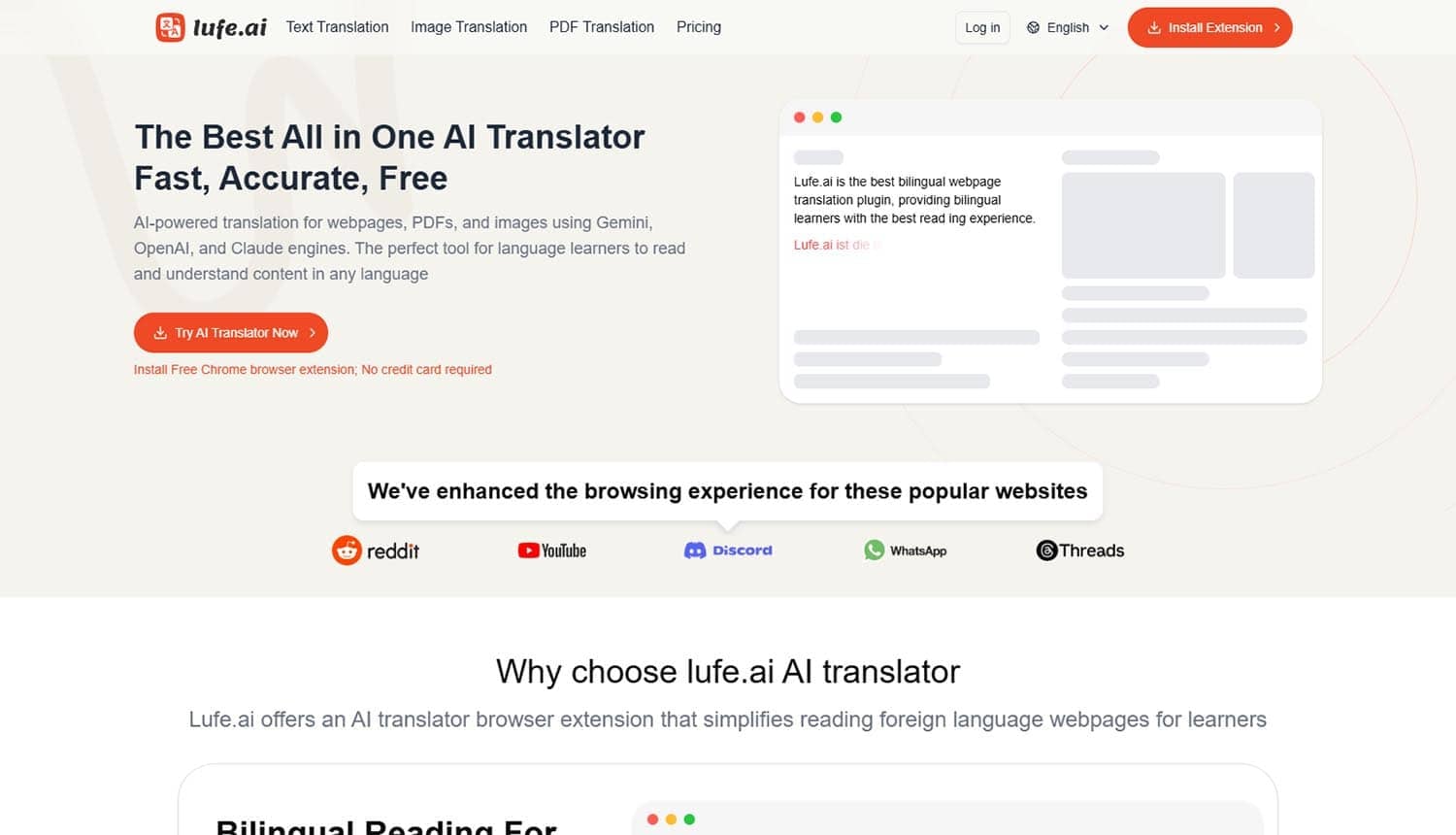

As the world becomes increasingly interconnected, the demand for reliable, efficient, and accurate AI translators has never been higher. From business communications to personal language learning, these tools have revolutionized how we interact with people and content in different languages. This article reviews five AI-powered translation tools, highlighting their features, strengths, and potential drawbacks. Among them, Lufe.AI stands out for its versatility and seamless user experience, catering to both casual users and professionals.
1. Lufe.AI
Lufe.AI is a highly intuitive AI translator that combines cutting-edge artificial intelligence engines like Gemini, OpenAI, and Claude to provide comprehensive translation solutions. Its standout features include bilingual webpage translation, image recognition, and PDF file translation, making it a go-to choice for both language learners and professionals seeking accuracy and convenience.
Pros
- Bilingual Webpage Translation: Lufe.AI makes bilingual reading easy, offering side-by-side translations for learners and professionals to better understand nuances and context. This feature is particularly helpful for translating language pairs like Spanish to English, ensuring users grasp both literal and contextual meanings.
- Multi-Engine Support: By integrating multiple engines, including OpenAI and Google, Lufe.AI ensures precise and context-aware translations. Its ability to use advanced AI translator technology makes it a reliable choice for complex content.
- Customizable Display: Users can personalize the translation style, font, and layout, enhancing their overall reading experience to suit their preferences.
- Image and PDF Translation: The tool supports text recognition in images and PDF files, translating content while preserving formatting, making it ideal for academic or professional use.
- Ease of Use: With its browser extension and mobile compatibility, Lufe.AI is easy to access and use anytime, anywhere, simplifying tasks such as translating Spanish to English for quick understanding.
Cons
- Limited Free Features: While the basic features are free, advanced options like AI-powered contextual translations require a paid subscription.
- Learning Curve: Some users may need time to explore and fully customize all the available features, especially when using the more complex aspects of its AI translator functionality.
2. DeepL Translator
DeepL is widely acknowledged as one of the most accurate AI translation platforms available. Known for its natural language processing prowess, it delivers high-quality translations that maintain the context and tone of the original text. DeepL supports a variety of languages and offers tools like document translation and DeepL Write for refining writing style.
Pros
- Exceptional Accuracy: DeepL excels in translating complex sentence structures and maintaining the intended meaning.
- Document Translation: Users can upload PDFs, Word documents, and PowerPoint files for translation while preserving original formatting.
- DeepL Write: This writing assistant helps users tailor their text to specific audiences, improving tone and readability.
Cons
- Character and File Limits: The free version only supports up to 3,000 characters per translation, limiting its usefulness for larger projects.
- Language Coverage: While DeepL supports many popular languages, it doesn’t cover as many as some competitors.
3. ShopiBar Plugins
ShopiBar specializes in WhatsApp plugins designed for businesses, offering tools like WA Real-Time Translation and WA Message Broadcaster. These plugins are ideal for companies that rely on WhatsApp for cross-border communication and marketing.
Pros
- Real-Time Translation: ShopiBar’s plugins support multiple translation engines, enabling seamless multilingual communication on WhatsApp.
- Broadcast Messaging: The WA Message Broadcaster plugin allows users to send bulk messages efficiently, with customizable templates for different audiences.
- User-Friendly Shortcuts: The Scroll Down for WhatsApp plugin improves navigation for users managing large contact lists.
Cons
- Narrow Focus: ShopiBar’s tools are tailored specifically for WhatsApp, limiting their appeal to businesses that don’t use the platform extensively.
- Integration Issues: Some users have reported compatibility problems with older devices or browsers.
4. Trancy
Trancy is an immersive translation tool designed with language learners in mind. From bilingual subtitles on YouTube and Netflix to AI-powered word lookup, Trancy offers a unique combination of learning aids and translation features, making it a favorite among students and enthusiasts.
Pros
- Bilingual Subtitles for Videos: Trancy supports platforms like YouTube, Netflix, and TED, offering subtitles in both the original language and translated content for enhanced learning.
- Customizable Learning Tools: Users can highlight words, adjust subtitle fonts, and save favorite phrases for future review.
- AI Grammar Analysis: Trancy provides grammar breakdowns for complex sentences, helping learners understand structure and syntax.
Cons
- Subscription Model: Many advanced features, such as real-time bilingual subtitles, require a paid subscription.
- Platform Limitation: While Trancy supports popular streaming platforms, it doesn’t extend its functionality to other types of content like PDFs or static images.
5. Smartcat
Smartcat is an all-in-one AI translation platform designed for businesses. Combining AI translation with human editing workflows, it’s ideal for large-scale projects requiring high levels of accuracy. Smartcat also integrates with over 50 tools, including Google Docs, WordPress, and Figma, making it a versatile solution for localization and content management.
Pros
- Comprehensive Workflow Integration: Smartcat supports a wide range of tools and platforms, streamlining translation workflows for teams.
- Linguist Marketplace: With access to 500,000+ translators and editors, Smartcat ensures professional-level translations for any project.
- Scalable for Businesses: The platform’s AI-human hybrid model reduces costs and improves turnaround times for enterprise-level translations.
Cons
- Complexity for Beginners: Smartcat’s extensive features may feel overwhelming for users unfamiliar with translation management systems.
- Cost: While the platform offers a free version, businesses looking to unlock its full potential must invest in a paid plan.
Final Thoughts
Each of the tools reviewed here excels in specific areas, catering to different user needs. Lufe.AI stands out for its user-centric features, offering a blend of translation accuracy, accessibility, and customization that’s hard to beat. While DeepL and Smartcat cater to businesses and professionals, Trancy and ShopiBar plugins focus on specific use cases like language learning and WhatsApp communication.
For those looking for a versatile solution that combines bilingual webpage translation, image recognition, and PDF support, Lufe.AI is a clear winner. Its seamless integration of multiple AI engines ensures accurate and context-aware translations, making it an indispensable tool for learners, researchers, and professionals alike. As AI translation technology continues to evolve, platforms like Lufe.AI are paving the way for a more connected and multilingual world.
