


In today’s fast-paced digital landscape, IT Operations Management is the backbone of any successful business. ITOM’s focus usually revolves around keeping services up and running through monitoring , alerts, and fault management. But as modern IT environments become increasingly distributed and cloud-native, traditional ITOM faces critical challenges like delayed troubleshooting, data silos, and slow root cause analysis.
This is where Observability steps in as the crucial next evolution. More than just monitoring, observability provides a holistic, proactive, and deep understanding of system health and behavior, making it an indispensable tool for modern ITOM.
What is Observability?
Though often mistaken as synonymous, monitoring and observability are fundamentally different. Monitoring tells you whether a system is up and running. Observability goes deeper, it enables you to investigate and understand a system’s internal workings through its data, helping you diagnose issues,, helping you diagnose issues you didn’t even predict.
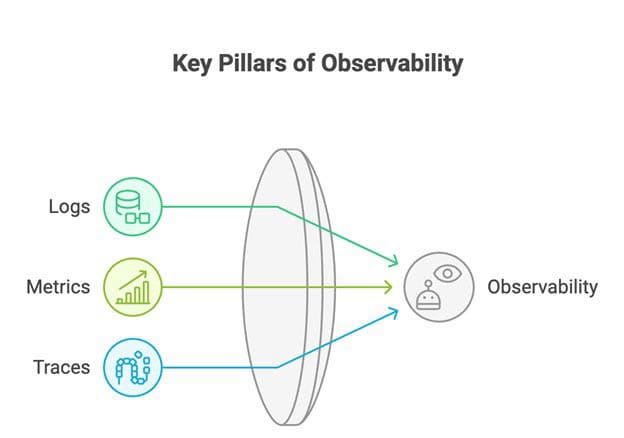
Observability has three primary pillars,
- Metrics – Metrics are excellent for aggregated views, trend analysis, and dashboard purposes.
- Logs – Logs are invaluable for debugging and understanding the sequence of events leading to an issue.
- Traces – Traces provide end-to-end visibility, revealing latency sources and dependencies, which is critical in microservices architectures.
Key advantages of implementing Observability
Integrating Observability in your IT Operations Management brings a multitude of benefits, transforming reactive operations into proactive insights including,
- Identify issues proactively – Observability empowers IT teams to collect and examine comprehensive data, allowing them to spot minor irregularities and performance declines before they grow into critical failures that disrupt user experience
- Automated and quicker root cause analysis – With integrated metrics, logs, and traces, IT teams can quickly navigate from an alert to the precise root cause of the problem, helping them resolve issues much faster and lowering MTTR.
- Better incident response – When critical incidents occur, observability tools provide the end-to-end context that helps teams quickly troubleshoot, respond efficiently, and keep downtime to a minimum.
- Support for complex architectures – For dynamic environments like microservices, cloud-native solutions, containers, and serverless functions, traditional monitoring often falls short. Observability, by design, delivers the visibility needed to navigate these dynamic, short-lived, and distributed systems.
If Observability offers so much benefits, why is it still controversial? Why does enterprises often think they’re not up for it?
Common challenges in adopting Observability
Observability is well-suited for modern, ever-evolving network architectures, though some hurdles can complicate its adoption.
Let’s look at the common challenges in adopting Observability,
Limited budgetary allocations and resource availability:
Network observability demands considerable investment, and its costs can quickly skyrocket. Up-and-coming businesses frequently struggle to achieve full-stack observability due to funding limitations. The key is to select observability vendors offering adaptability, reliability, and strong value.
Challenges in integrating observability with current IT infrastructure and tools:
One of the main hurdles in adopting observability is integrating it seamlessly with existing tools and systems.
Thankfully, many full-stack observability solutions on the market now offer out-of-the-box integrations specifically designed for dynamic IT environments. When choosing an observability solution, it’s crucial to ensure it can be customized to fit your unique operational landscape .
High operational overhead for Observability tools:
Observability solutions often present significant implementation and maintenance complexities. This is usually due to the challenges posed by highly distributed systems, the sheer volume of data generated, insufficient skilled IT staff, and inherent infrastructure instability.
Therefore, when selecting a solution, it’s crucial to choose tools that provide strong scalability and dedicated support to navigate the complexities of modern network environments effectively and maintain network uptime.
Hesitancy towards adopting new technologies:
Adopting new technologies often meets with internal pushback. Companies may hesitate due to concerns about investing in unfamiliar tools, past failures, insufficient training resources, or financial uncertainty. By addressing these obstacles, businesses can more confidently embrace innovations like observability in their network environments.
Against all these issues, what makes Observability critical for Modern ITOM?
Here are some of the challenges IT admins face to uphold the uptime of their IT.
Challenge 1: Slower Root cause analysis
Solution:
Observability. Imagine a critical service suddenly goes down. How do you know where the problem is? How do you trace the problem?
This is where Observability helps. By providing a holistic, interconnected view of system behavior, observability significantly accelerates root cause analysis. It unifies metrics, logs, and traces, enabling IT teams to quickly pinpoint issues. Anomaly detection via metrics allows immediate drill-downs into correlated logs and traces, visualizing problematic transaction journeys, and rapidly diagnosing “unknown unknowns” to reduce MTTR.
Challenge 2: Alert fatigue and noise
Solution:
Observability significantly combats alert fatigue and noise by moving beyond simplistic monitoring to provide context-rich, correlated insights. Instead of isolated warnings, observability platforms unify metrics, logs, and traces, enabling intelligent alert grouping where multiple related alerts are consolidated into a single incident.
Not only that, they also utilize ML-powered anomaly detection and dynamic thresholds to identify genuine deviations, significantly reducing false positives and non-actionable alerts. This allows IT teams to focus on critical issues and avoid alert fatigue.
Challenge 3: Unskilled team
Solution:
Unified observability platforms give IT Teams a shared, clear view of system health. This common understanding helps them work together better and efficiently solve the problems that arise.
Challenge 4: Performance issue and negative user impact
Solution:
Observability correlates real-time metrics, logs, and traces to detect subtle slowdowns. Tracing shows the full path of a user’s request, pinpointing exact bottlenecks. This indepth insight helps teams quickly understand why performance is degrading, allowing them to fix problems before users are affected.
Challenge 5: Managing hybrid/complex environments
Solution:
Observability simplifies managing complex, hybrid environments by offering a single, unified view of all the devices, whether they’re on-premises or in various clouds. It collects metrics, logs, and traces to map device dependencies and help teams quickly see how a minor issue that occured in one place affect others enabling quicker troubleshooting and resolution.
The future of ITOM – What’s next?
Despite the adoption challenges we discussed about, Observability has proven to be essential in all aspects of monitoring an IT environment. Recently, ManageEngine had carried out a state of observability survey, it’s a report on adoption, challenges, and the path forward. There were around 1200+ respondents who predominantly are IT practitioners, over a period of 2 months across 75 countries worldwide. This report claims to offer a data-driven perspective on the state of Observability in 2025. The highlight of this report includes,
- Maturity Stage of the organizations in Observability adoption
- Adoption drivers that drives organizations towards the adoption
- Metrics and ROI that Observability brings to the table
- Adoption barriers
- AI gaps and needs &
- Priorities for the coming year
The report can be of great help in understanding where the other businesses stand in Observability adoption, understanding the kind of challenges involved, the kind of tools that are being used, use cases to justify the growing demand, and the impact incorporating observability has shown by far.
To summarize, Observability is no longer a luxury but a fundamental requirement for effective IT Operations Management in the modern IT era and tools like ManageEngine OpManager Plus are non-negotiable. By shifting from reactive monitoring to proactive, data-driven observability, organizations can gain unprecedented clarity into their complex systems empowering IT teams to detect issues faster, resolve them more efficiently, optimize performance, and ultimately uphold consistent network uptime.
